Volume 3 GENERAL TECHNICAL aDMINISTRATION
CHAPTER 43 EVALUATE A CONTINUOUS AIRWORTHINESS MAINTENANCE PROGRAM
Section 1 Evaluate a Part 121 and Part 135 Continuous Airworthiness Maintenance Program



3-3866 PROGRAM TRACKING AND REPORTING SUBSYSTEM (PTRS) ACTIVITY CODES AND AIR TRANSPORTATION OVERSIGHT SYSTEM (ATOS) REPORTING ELEMENT.
A. Maintenance: 3330.
B. Avionics: 5330.
C. ATOS Safety Attribute Inspection (SAI):1.2.1, 1.2.4, 1.3.1, 1.3.2, 1.3.3, 1.3.4, 1.3.5, 1.3.6, 1.3.7, 1.3.8, 1.3.9, 1.3.10, 1.3.11, 1.3.15, 1.3.23, 1.3.24, 2.1.1, 4.1.1, 4.1.2, 4.2.1, 5.1.1, 5.1.8, 7.1.1, 7.1.6.
3-3867 OBJECTIVE. This section provides the information, policy, and guidance that the inspector needs to evaluate a Title 14 of the Code of Federal Regulations (14 CFR) part 119 certificate holder’s Continuous Airworthiness Maintenance Program (CAMP) according to applicable 14 CFR regulations and Federal Aviation Administration (FAA) policy. The FAA wrote this section to agree with Advisory Circular (AC) 120-16, Air Carrier Maintenance Programs, because the AC is an acceptable method of compliance with the regulations. For the purpose of this section, a CAMP, a Maintenance, Preventive Maintenance, and Alteration Program are the same. The FAA intends for inspectors to use this section with the applicable SAI when evaluating the air carrier’s CAMP.
NOTE: This order contains other sections for some of the CAMP elements. For example, inspectors can find guidance for evaluating required inspections both in this section and in Volume 3, Chapter 43, Section 2. When another section exists, the inspector must follow the guidance in both sections as applicable when evaluating a CAMP.


3-3868 GENERAL.
A. Legal Basis of Air Carrier Maintenance Programs. To understand why 14 CFR parts 121 and 135 govern persons and the performance of all air carrier maintenance while other regulations, such as part 145, do not, it is essential to understand Title 49 of the United States Code (49 U.S.C.). The following information on 49 U.S.C. helps explain the different standards used for developing regulations for air commerce and regulations for air transportation.
1) Title 49 U.S.C. Title 49 U.S.C. § 44701 is the primary authority for all air carrier 14 CFRs. Title 49 U.S.C. § 44701 requires the FAA to promote the safe flight of civil aircraft in air commerce by prescribing regulations and standards in the interest of safety.
2) Air Commerce. When prescribing regulations and standards, § 44701 also requires the FAA to:
· Consider an air carrier’s duty to provide service with the highest possible degree of safety in the public interest,
· Consider differences between air transportation and other air commerce, and
· Classify a regulation or standard appropriate to the differences between air transportation and other air commerce.
a) Title 49 U.S.C. §40102 defines the term “air commerce” as:
· Foreign air commerce,
· Interstate air commerce,
· Transportation of mail by aircraft,
· Operation of aircraft within the limits of a Federal airway,
· Operation of aircraft that directly affects, or may endanger safety in, foreign or interstate air commerce.
b) Operations in air commerce include almost every type of operation but air transportation.
3) Regulations. Consistent with the requirements of § 44701, the FAA regulates aircraft operations at different levels of safety. Therefore, FAA regulations that govern air carrier operations (air transportation) and the operations of other air commerce have different structures to reflect the differences between these two segments of the aviation industry. Establishing appropriate standards and regulatory requirements is a risk management process, and the underlying legal structure provides for more than one level of acceptable risk appropriate to different types of flight operations. Air transportation regulations are all-inclusive and stand alone, whereas the regulations governing other air commerce are not. Similarly, the scope of responsibility for those in air transportation operations is very broad and not shared (e.g., the air carrier is responsible for the performance of maintenance and airworthiness of its aircraft), whereas in other air commerce, the scope of responsibility is relatively narrow and commonly shared (e.g., the owner/operator in 14 CFR part 91 is responsible for having maintenance performed on its aircraft and the mechanic is responsible for the performance of maintenance and airworthiness of the aircraft). The regulations in parts 119, 121, and 135 relate directly to air carrier maintenance programs and reflect the highest possible degree of safety in the public interest. The regulations in 14 CFR parts 43, 65, 91, and 145 do not necessarily reflect the highest possible degree of safety in the public interest. This section contains specific references to relevant regulations in subsequent paragraphs.
4) Performance-Based Regulations. Most of the part 121 and part 135 maintenance regulations appear in a performance-based format. The performance-based regulatory approach focuses on measurable outcomes, rather than prescriptive processes, techniques, or procedures. Performance-based regulation leads to defined results without specifying directions or instructions regarding how to obtain those results. This approach permits these regulations to apply to a wide variety of certificate holders and still have the same standards. For example, the performance-based regulations at part 121, § 121.367 and part 135, § 135.425 apply equally to all operators, regardless of number of aircraft. The defined result is always an airworthy aircraft that the air carrier has properly maintained for operations in air transportation. Performance-based regulation also permits the regulation to remain current in the face of advances in technology or methodology.
5) Acceptable Means of Compliance. Performance-based regulation also explains what constitutes an acceptable means of compliance. This section shows acceptable methods of compliance with the performance-based maintenance program regulatory requirements, including descriptions of processes, techniques, and procedures that will lead to the defined results in the maintenance regulations. The air carrier should tailor its maintenance program to its particular and specific operation; therefore, regulations cannot provide a single means of compliance that applies to all certificate holders required to develop and implement an air carrier maintenance program.
6) Continuous Airworthiness Program (CAP). The FAA introduced the CAP in a final rule at 29 Federal Register (FR) 6522 on May 20, 1964. “CAMP” is a colloquial term for “CAP.” This 1964 rulemaking was the FAA’s response to safety concerns and discoveries of weaknesses in the maintenance programs of some air carriers that the FAA found during accident investigations and surveillance of operator maintenance activities. The FAA designed the air carrier CAP to strengthen requirements for air carrier safety management activities. Each one of the air carrier maintenance program elements described in this section was a part of 29 FR 6522.
7) Requirements for a CAMP. The regulations require a CAMP for part 119-certificated air carriers operating under parts 121 and 135 with aircraft that have a passenger-seating configuration, excluding any pilot seat, of 10 or more seats. For part 135 operations, this guidance applies to any aircraft using the maintenance program provisions of § 135.411(a)(2). It also applies to air carriers choosing to maintain its aircraft under a CAMP as provided in § 135.411(b) and air carriers choosing to operate under § 135.364, Extended Operations (ETOPS), as provided in § 135.411(d).


B. Maintenance Program Authorization. The FAA does not approve air carrier maintenance programs because there is no regulation that requires approval. However, the FAA issues air carrier operations specifications (OpSpecs) to the air carrier, authorizing it to use a maintenance program and the air carrier maintenance manual required by the FAA regulations. Tailored to the air carrier’s specific operating context and the requirements of its individual operations, the OpSpecs convey the general terms of regulations into specific terms, conditions, and limitations. The FAA amends the OpSpecs as circumstances dictate. Issued by the FAA, the OpSpecs are legally binding through specific regulatory language (see part 119, § 119.33 for the applicable language). See 8900.1, Volume 3, Chapter 18, Section 1 for additional information on OpSpecs.

C. Air Carrier Maintenance Program Objectives.
1) Program Objectives. The air carrier’s maintenance program must ensure the following three specific program objectives stated in §§ 121.367 and 135.425 in order to provide the highest possible level of safety in air transportation.
a) Maintenance, preventive maintenance, and alterations performed by it, or by other persons, are performed in accordance with the certificate holder’s maintenance manual;
b) Competent personnel and adequate facilities and equipment are provided for the proper performance of maintenance, preventive maintenance, and alterations; and
c) Each aircraft released to service is airworthy and has been properly maintained for operation under this part.

2) Continuing Analysis and Surveillance System (CASS). The air carrier’s maintenance program must also have a system of continuing surveillance, investigation, data collection, analysis, corrective action, and corrective action followup that ensures all parts of its maintenance program are effective and are being performed in accordance with the air carrier’s manual. “Effective” means that the air carrier is achieving the desired results according to the maintenance program objectives and the standards that the air carrier set. “Program performance” means that all personnel, including air carrier maintenance providers, are following the air carrier’s program as it has documented in its manual.
D. Air Carrier Maintenance Program Elements. The air carrier’s maintenance program must include the following 10 elements. Individual explanations of each of these elements appear in paragraphs 3-3869 through 3-3878.
· Airworthiness responsibility.
· Air carrier maintenance manual.
· Air carrier maintenance organization.
· Accomplishment and approval of maintenance and alterations.
· Maintenance schedule.
· Required Inspection Items (RII).
· Maintenance recordkeeping system.
· Contract maintenance.
· Personnel training.
· CASS.




3-3869 AIRWORTHINESS RESPONSIBILITY.
A. Responsibility for Aircraft Maintenance.
1) Part 119 Certificate Holder Responsibilities. Consistent with §§ 121.363 and 135.413, the air carrier (as a part 119 certificate holder,) is primarily responsible for the airworthiness of its aircraft and the performance of all of the maintenance or alterations on its aircraft. A keyword in the previous statement is “primarily,” which recognizes responsibilities associated with other persons that perform maintenance for the air carrier. The air carrier’s certificate makes it a maintenance entity. Under its air carrier certificate, it may accomplish its own maintenance, preventive maintenance, or alterations, or it can use other persons who are not direct employees to accomplish that work. Parts 121 and 135 govern each person that the air carrier uses or that it employs for any maintenance, preventive maintenance, or alteration of its aircraft (see §§ 121.1(b) and 135.1(a)(2)). Each person that the air carrier uses must be under the air carrier’s direction and control and must follow the air carrier’s maintenance program. Recognizing parts 121 and 135 as the governing regulations for the performance of all air carrier maintenance by all persons is important to understanding why other regulations such as part 145 do not govern air carrier maintenance.
2) Maintenance Responsibilities. For any work completed on the air carrier’s aircraft, the air carrier retains direct and primary responsibility for performing and approving all maintenance and alterations, whether it accomplishes that work or someone else does it for them (e.g. a maintenance provider, such as a repair station). The air carrier always retains primary responsibility for the performance and approval of the maintenance completed by that maintenance provider.
B. Differences Between Programs. The following table provides a comparison of the differences between air carrier maintenance programs (air transportation) and part 91 general aviation inspection programs (air commerce).
Table 3-125. Air Carrier Maintenance Programs and Part 91 General Aviation Inspection Programs
|
Element |
14 CFR Part 91 Owners/Operators |
|
|
Use of a maintenance or an inspection program. |
Required to use a maintenance program for its aircraft. |
Required to use an inspection program. |
|
Responsibilities within the relevant program. |
Responsible for the performance of maintenance in accordance with its maintenance program and manual, as well as the airworthiness of its aircraft, including airframes, aircraft engines, propellers, appliances, and parts thereof. |
Responsible for maintaining the aircraft in an airworthy condition (part 91, § 91.403). |
|
NOTE: The wording in part 91 is deliberately different from the wording in 14 CFR parts 121 and 135 and is consistent with the difference between air carriers and other air commerce as described in Title 49 of the United States Code (49 U.S.C.) § 44701. |
||
|
Responsible for the development and use of the maintenance program and manual, determining the method of performing maintenance, a required inspection list, a Continuing Analysis and Surveillance System (CASS), a maintenance organization that can exercise operational control over maintenance operations, and other items that collectively and systematically serve to ensure that each aircraft has been properly maintained for operations in air transportation and is airworthy. |
Responsible for the selection of an existing inspection program, scheduling aircraft for inspection, and ensuring that persons authorized to perform and approve maintenance, preventive maintenance, and alterations repair and approve discrepancies that occur between scheduled inspections. |
|
|
|
Must determine what maintenance is required, how to do it, when to do it, perform that maintenance, and approve its own aircraft for return to service. May authorize another person to accomplish the maintenance work, but the other person must carry out the maintenance work according to the air carrier’s maintenance program and manual. The air carrier retains the responsibility for the proper completion of maintenance (part 121, § 121.363 or part 135, § 135.413). |
Must make the airplane available to authorized and certificated person(s) who accomplish inspections and other maintenance. |
|
Along with the Federal Aviation Administration (FAA) oversight, it is the primary authority with regard to its maintenance program. Holds the primary responsibility for the performance of maintenance in accordance with its maintenance program and manual, as well as the airworthiness of its aircraft, including airframes, aircraft engines, propellers, appliances, and parts thereof. |
The authorized and certificated person(s) has the responsibility to perform the maintenance properly in accordance with the manufacturer’s manual and to approve the aircraft for return to service. The owner/operator does not have this responsibility. However, the owner/operator is responsible for ensuring that maintenance personnel make appropriate entries in the aircraft maintenance records indicating that the aircraft has been approved for return to service. |
|

3-3870 AIR CARRIER MAINTENANCE MANUAL. Also see Volume 3, Chapter 32, Sections 6, 7, 8, and 11.
A. Air Carrier Maintenance Manual Requirement.
1) Maintenance Manuals. The FAA regulations (§§ 121.133, 121.369, 135.21, and 135.427) require the air carrier to have a maintenance manual. It is a required part of the air carrier manual system. Some air carriers call their manuals “specifications” and some use other terms. Traditionally, the air carrier has geared its maintenance manual toward maintenance performed in-house by its employees. If the air carrier chooses to use another person to perform maintenance for it, it must have well-defined maintenance procedures in its manual for the maintenance provider to follow.
2) Revising Maintenance Manuals. The air carrier’s maintenance manual must be easy to revise and have procedures for keeping all parts of the manual up to date. The manual may be electronic or in another form.
3) Current and Available. The air carrier must make copies of its manual or appropriate portions of it (and changes or additions) available to those persons required to comply with it. Additionally, the air carrier must furnish its manual to principal inspectors (PI) assigned to the air carrier. Each person who receives a manual or appropriate parts from the air carrier must keep it up to date.
4) Interface Attribute. The air carrier’s maintenance manual must interface with other air carrier manuals such as those required by part 121 subpart G and § 135.21. Interfaces occur in a procedure where the responsibility for accomplishing work is transferred from one person, work group, or organization to another. (For example, if an aircraft discrepancy occurs during flight operations and the discrepancy must be fixed, operations transfers control to maintenance. When maintenance is finished, they transfer control back to operations.) Procedures must be detailed to ensure the smooth transfer of work and information.
5) Other Related Regulations. Other regulations that relate to air carrier manual requirements are part 43, § 43.13(c), §§ 121.135, 121.137, 135.23, and 135.427.

B. Role of the Air Carrier Maintenance Manual.


1) Standardization. The air carrier’s maintenance manual is its key to standardized, consistent accomplishment and administration of its maintenance program. The air carrier’s maintenance manual:
a) Identifies, describes, and defines its maintenance program.
b) Provides instructions and procedures to administer, use, manage, and amend its program.
2) Organization and Format. The air carrier’s maintenance manual is a company publication, and the air carrier has sole responsibility for its organization and content; however, others may compile and publish it for the air carrier. The air carrier’s maintenance manual may be electronic.
C. Major Sections of the Typical Air Carrier Maintenance Manual.

1) Organization of the Air Carrier’s Maintenance Manual. The air carrier’s maintenance manual should have a practical organization. Typically, it will have at least three sections covering administrative policies and procedures; detailed instructions for the administration, management, and accomplishment of the elements of its maintenance program; and technical data that describes maintenance standards, methods, techniques, and procedures.
2) Administrative Policies and Procedures. The primary function of this part of the air carrier’s manual is as a management and administrative tool for organizing, directing, amending, and controlling its maintenance program. Usually, the air carrier will place required organizational charts delineating the functions, relationships, and lines of authority between its organizational elements and personnel in its manual. The air carrier may list position descriptions, duties, responsibilities, and specific authority and responsibility attributes for each position within its maintenance organization in its manual. The authority and responsibility attributes that the air carrier incorporates should show who has overall authority and/or responsibility and who has direct authority and/or responsibility for given functions.
3) Instructions for the Administration, Management, and Accomplishment of the Maintenance Program.
a) This section contains detailed instructions for the air carrier’s management of the various functions and interrelationships of each maintenance program element, such as maintenance time limitations, recordkeeping, Airworthiness Directive (AD) management, maintenance program management and oversight, contract maintenance management and oversight, and personnel training. This section usually includes a description of the air carrier’s scheduled maintenance tasks, procedural information, and detailed instructions (or specific air carrier maintenance manual references) for accomplishing its maintenance tasks. Additionally, the air carrier should describe criteria for initiating functional evaluation flights (see § 91.407) in this part of the maintenance manual, along with procedural requirements for them. In this portion of the air carrier’s manual, the air carrier should also include criteria and procedural information for unscheduled inspections, such as those associated with lightning strikes, tail strikes, exceeding engine temperature, hard or overweight landings, and any very high-load event.

b) The air carrier should have a comprehensive process in the unscheduled maintenance portion of its manual that addresses those rare, extremely high-load events that occur to aircraft. Specifically, the air carrier should have inspection processes that it should use following certain high-load events. These particular high-load events are those for which flight data might facilitate the subsequent inspection process. The air carrier should consider the events listed below as most significant:
1. Flight Events.
· A severe turbulence encounter,
· Extreme maneuvers,
· Exceeding speed limitations, and
· Heavy stall buffet.
2. Ground Events.
· Hard landings,
· Over-weight landings, and
· Drift landings resulting in excessive side/drag load.

c) Typically, the Original Equipment Manufacturer (OEM) will include detailed inspection instructions that the air carrier should follow after these high-load events. The objective of these instructions is to detect aircraft damage following an in-service flight or ground event. While there are many conditions that can result in high loads on the airframe and subsequent structural damage, the FAA considers the use of flight data in the air carrier’s inspection process to be particularly beneficial for the events identified above.
d) The air carrier’s processes for evaluating these events should address an appropriate indication that an event has occurred, an evaluation of the severity of the event, and coordination with the manufacturer, as appropriate.
e) The air carrier’s special inspection procedures for high-load events should:
· Identify that a very high-load event has occurred;
· Assure that indications of structural damage are found in an initial inspection;
· Involve the OEM, if necessary;
· Provide a process for additional inspections that are designed to identify all of the structural damage; and
· Provide a process for approval for return to service.
D. Technical Data That Describe Maintenance Standards, Methods, Techniques, and Procedures.

1) Program Management and Technical Data. This section of the air carrier’s manual concerns detailed procedures for accomplishing specific tasks (e.g., methods, techniques, technical standards, measurements, calibration standards, operational tests, structural repairs). The air carrier should also include procedures for aircraft Weight and Balance (W&B), jacking, lifting, shoring, storage, cold weather operations, towing, aircraft taxi, and aircraft cleaning. The air carrier can derive its maintenance manual contents from the manufacturer’s publications. However, based on the air carrier’s particular service experience, organization, and operating context, the FAA expects the air carrier to continuously modify and customize its maintenance manual as necessary for the continuing success of its maintenance program. This is one of the desired outcomes of a well-functioning CASS.
2) ADs. The air carrier is required to accomplish the provisions of part 39 ADs. The air carrier should have a management process in its manual for evaluating, accomplishing, and verifying ADs. The air carrier’s AD management process (refer to Volume 3, Chapter 59, Section 1, Airworthiness Directive Management Process and Alternative Method of Compliance) should contain the following six elements: planning, support, provisioning, implementing, recording, and auditing. The air carrier may not operate the aircraft that an AD applies to except in strict compliance with the provisions of the AD. Therefore, it is extremely important that the air carrier include in its AD process provisions to ensure that:
a) It reviews ADs for applicability to its aircraft;
b) If needed, it submits and receives FAA approval for an alternative method of compliance (AMOC);
c) It accomplishes the requirements of the AD within the time frame specified in the AD;
d) It keeps records of the accomplishment and current status of each AD that applies to its aircraft; and
e) Any subsequent maintenance or alteration to its aircraft does not remove the maintenance or alteration that the AD mandated.
NOTE: If the air carrier does subsequently remove the AD-mandated maintenance or alteration, it will be in violation of part 39 and may introduce an unsafe condition into its airplane. It would also make the required records for that particular AD inaccurate.
3) Work Cards.
a) Work cards (task cards), while not a specific regulatory requirement, have evolved as a best practice. The FAA considers work cards to be part of the air carrier’s manual and the air carrier’s maintenance program. They are the “what to do” and “how to do it” parts of the air carrier’s responsibility to accomplish maintenance and alterations on its aircraft. An air carrier uses work cards as a simple means of complying with regulations for performing maintenance as well as maintenance recordkeeping. The air carrier’s work cards provide detailed, concise procedural instructions that organize and control its maintenance activities while providing a means to ensure that its maintenance activities comply with its air carrier maintenance manual. It is an easy way for the air carrier to make sure that its maintenance and other personnel are following its procedures. The air carrier must document its process for developing and controlling work cards in its manual. If the air carrier develops its own work cards based on a manufacturer’s instructions, it must ensure that they have transcribed the information completely and accurately.

b) The air carrier should give special attention to work cards involving required inspections and flight control systems to ensure that they are accurate and contain complete and relevant technical data and drawings. The air carrier should include discrete (separate or distinct) tasks with individual inspection sign-off requirements for post-rigging verification. Another function of the work card is to document the air carrier’s maintenance activities, providing a means for the air carrier to comply with its air carrier maintenance recordkeeping requirements. Work cards may also document the results of inspections, checks, and tests for data collection and analysis. The air carrier conducts work‑in‑progress audits of work card activities under its CASS to ensure that each individual who accomplishes work on its aircraft is following its manual.
3-3871 AIR CARRIER MAINTENANCE ORGANIZATION.
A. General Organizational Requirements. The air carrier’s maintenance organization must be able to perform, supervise, manage, and amend its program; manage and guide its maintenance personnel; and provide the direction necessary to achieve its maintenance program objectives. The regulations require the air carrier to include a chart or a description of its maintenance organization in its manual. Part 121 subpart L, part 135 subpart J, and portions of part 119 subpart C discuss maintenance organization requirements. These organizational regulations apply to the air carrier’s organization, as well as any other organization that provides maintenance services for the air carrier. A chart is a good way to show the air carrier’s assignment of overall and direct authorities and responsibilities.
B. Required Maintenance Organization Management Positions. Section 119.65 includes specific requirements for maintenance management positions for operations under part 121. A Director of Maintenance (DOM) and a chief inspector, or equivalent positions, are required by the regulations; however, they are not all of the management positions that the air carrier will need to administer and manage its maintenance organization.
1) Part 121 and 135 Required Positions. For operations conducted under part 121, § 119.65 requires the air carrier to have qualified individuals serving full-time as the DOM and chief inspector, or in equivalent positions. If necessary for the air carrier’s operation, the air carrier can ask the FAA for a deviation from the types and numbers of required part 121 or 135 management positions.
2) Chief Inspector. For operations that the air carrier conducts under part 135, § 119.69 requires the air carrier to have a qualified individual serving in the DOM management position, but there is no regulatory requirement for a part 135 chief inspector management position. However, in a practical sense, the air carrier will have an individual in its part 135 maintenance organization that has direct responsibility for the RII function, as well as those other duties, responsibilities, and functions normally associated with a part 121 chief inspector. Additionally, § 135.429(b) implies a supervisor for the air carrier’s inspection unit.

3) Management Personnel. The regulations require the air carrier to state the duties, responsibilities, and authority of each of its management personnel in its manual. The air carrier should state who has overall authority and/or responsibility, and who has direct authority and/or responsibility for a given process. In addition, the air carrier must notify the FAA when it makes changes in its part 119 required management personnel or when it has a vacancy in one of those positions.
a) “Authority” means the power to design or change fundamental policy or procedures without having to seek higher-level approval. Authority is permission; it is a right coupled with an autonomous power to accomplish certain acts or order others to act. Often one person grants another authority to act, such as an employer to an employee, a corporation to its officers, or a governmental empowerment to perform certain functions.



b) “Responsibility” means a person’s obligation to ensure the successful completion of a task or function. Responsibility includes accountability for the action to carry out a task or function.
C. Required Air Carrier Maintenance Organization Structure.
1) Structure. The regulations that define an air carrier maintenance organization are broad given the different types and sizes of air carriers. It is not possible for a single means of compliance or a single organizational chart to apply to all the different types and sizes of air carrier organizations.
2) Accountable Person. The air carrier should designate a single manager (person or position) to have authority, overall responsibility, and accountability for managing and implementing the air carrier’s entire maintenance program, including all inspection functions. The inspection functions and the required inspection functions are part of the air carrier’s maintenance program.
3) Organizational Functions. The FAA recommends that the air carrier’s maintenance organization have three general organizational functions to ensure that the air carrier conducts all operations to the highest possible degree of safety. If the air carrier is a larger organization, it may have different departments for each level while in the smallest organizations, the air carrier may carry out these functions through one or two individuals, possibly as a collateral duty. Generally, these three organizational functional levels include:
a) Mechanics and/or inspectors performing the work at the first level (operations);
b) Middle managers and supervisors at the second level (tactics); and
c) The maintenance program accountable manager at the third level (strategy).
4) Authority and Responsibility. The FAA expects the air carrier to assign clear authority and responsibility in its maintenance organization, including responsibility for the overall maintenance program and all of its elements and functions. The air carrier’s manual should include a position description with each position’s duties and responsibilities in order to prevent a fragmented organizational system with a high risk for confusion over who is responsible for a given element, process, or task. The inspector should watch out for hidden duties and responsibilities where the air carrier shows a person’s duty and/or responsibility in a process but not in the position description.
D. Maintenance and Inspection Organizations.
1) Regulatory Requirements. If the air carrier performs maintenance and required inspections or if other persons perform these functions for the air carrier, there is a clear regulatory requirement in §§ 121.365 and 135.423 for a maintenance organization and a required inspection organization. There is no regulatory requirement to separate these organizations. However, there is a requirement to separate the functions that each organization performs.
NOTE: Do not confuse “inspection” with “required inspection” when evaluating the air carrier’s organization. “Inspection” is normally associated with an inspection department that performs scheduled type inspections on the aircraft such as “C” and “D” checks. However, “required inspection,” when used within the context of part 121, has a very specific meaning. An air carrier is not required by regulation to have an inspection department that performs scheduled inspections (although this is desirable), but an air carrier is required by regulation to have a required inspection organization that performs required inspections.

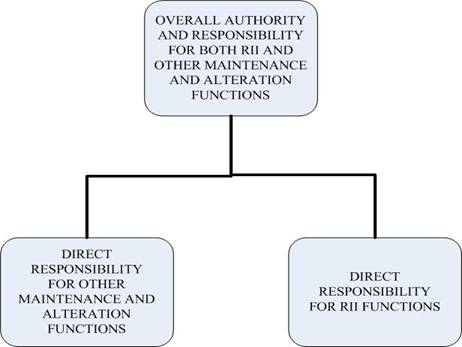
2) Organization. Sections 121.365(c) and 135.423(c) require the air carrier to organize the performance of all maintenance functions (e.g., inspection, repair, overhaul, and the replacement of parts) to separate the function of required inspections from the function of the other maintenance, preventive maintenance, and alteration activities. This organizational separation must be below the level of administrative control where the air carrier exercises overall responsibility for the required inspection functions as well as the other maintenance, preventive maintenance, and alteration functions. See Figure 3-131A for a representative organizational chart.
Figure 3-141. Typical Part 121 Organizational Chart Showing the Organizational Separation of the Required Inspection Items Function and the Other Maintenance, Preventive Maintenance, and Alteration Functions


3-3872 ACCOMPLISHMENT AND APPROVAL OF MAINTENANCE AND ALTERATIONS.
A. Accomplishment of Maintenance.
1) Performing Maintenance. As a maintenance entity, the air carrier has authorization under §§ 43.3(f), 43.7(e), 121.379, and 135.437 to perform maintenance on its own air carrier aircraft and to approve them for return to service without obtaining any other maintenance certification. In addition, §§ 121.379 and 135.437 provide clear authority for the air carrier, under its air carrier certificate, to perform maintenance on behalf of other air carriers that conduct operations under the same part as the air carrier.
2) Airman Certificate. Each individual who makes an airworthiness determination on the air carrier’s behalf must hold an appropriate airman certificate. Sections 121.378 and 135.435 require that any individual who the certificate holder puts directly in charge of performing maintenance hold an airman certificate. Sections 121.371 and 135.435 require that any individual the air carrier authorizes to perform its RII holds an appropriate airman certificate. Sections 121.709 and 135.443 require that anyone who the air carrier authorizes to issue an approval for return to service holds an appropriate airman certificate. The air carrier’s DOM and chief inspector must hold an airman certificate with Airframe and Powerplant (A&P) ratings. All of these requirements for an airman certificate are imposed on the air carrier, not the individual. The individual performing the function is not exercising the privileges of his or her certificate because the privileges of the airman certificate do not include the performance of part 121 requirements. Additionally, the authority to perform the required part 121 function is derived from the air carrier’s certificate, not the individual’s airman certificate. The air carrier accomplishes all maintenance and approval for return to service on its aircraft under its air carrier certificate by its maintenance organization or persons authorized by it, not by any individual or organization under their own individual certificate. There is, however, one exception to the individual airman certificate requirement. It occurs if the air carrier arranges for a certificated repair station (CRS) located outside the United States to perform maintenance. At such repair stations, individuals directly in charge of performing maintenance or required inspections are not required to hold an FAA airman certificate.


B. Major Repairs and Alterations. Under §§ 121.379(b) and 135.437(b), major repairs and alterations must be completed in accordance with technical data approved by the FAA. Part 43 appendix A contains a list of repairs and alterations that are considered major. However, the air carrier should not consider the list to be all-inclusive. Rather, they should consider the list to be examples of major repairs and alterations. The air carrier must also consider the definitions in 14 CFR part 1 for major repairs and alteration when classifying repairs and alterations The air carrier should have detailed major/minor classification procedures in its manual to evaluate each repair or alteration on a case‑by‑case basis using such factors as the certification basis of the aircraft; classification of the structure as primary, secondary, or a primary structural element; or classification as a fail-safe, safe-life, or damage-tolerant structure.
C. Airworthiness Release Form or Aircraft Log Entry and Approval for Return to Service. After performing any maintenance on its aircraft, the air carrier must approve it for return to service before the air carrier may operate it. The air carrier must issue an approval for return to service under § 121.709 or § 135.443, as appropriate.
D. Scope of Maintenance. The air carrier must provide instructions in its maintenance program and maintenance manual for maintenance and alterations encompassing “what to do,” “when to do it,” how to do it,” and “was it completed properly” in at least three major areas:

1) Scheduled Maintenance. Scheduled maintenance consists of all the individual maintenance tasks performed according to the maintenance time limitations (maintenance schedule). The air carrier’s scheduled maintenance activities should include procedural instructions for the maintenance tasks and requirements to record the results of the inspections, checks, tests, and other maintenance. The air carrier’s procedures should also provide for time-related activities such as recurring ADs, Certification Maintenance Requirements (CMR), and life-limited parts retirement.

2) Unscheduled Maintenance. Unscheduled maintenance includes procedures, instructions, and standards for maintenance that occurs on an unscheduled or unforeseen basis. A need for unscheduled maintenance may result from scheduled maintenance tasks, pilot reports, or unforeseen events, such as high-load events, hard or overweight landings, tail strikes, ground damage, lightning strikes, or an engine over-temperature. In the air carrier’s maintenance manual, the air carrier should include instructions and standards for the accomplishment and recording of unscheduled maintenance and detailed procedures for recording all types of unscheduled maintenance.
3) Specific Maintenance Requirements for Major Aircraft Components.
a) Engine Maintenance Program. The air carrier’s engine maintenance program should cover the maintenance of installed engines and off-wing engines for each engine model it operates. If the air carrier’s aircraft have auxiliary power units (APU), it may want to include APU maintenance as part of its engine maintenance program. Usually, the installed engine or APU requirements will be contained in the maintenance time limitations. In addition to procedural information, the off-wing program described in the air carrier’s maintenance manual should provide shop scheduling information or intervals for cleaning, adjusting, inspecting, testing, and lubricating each part of the engine or APU requiring that maintenance. The air carrier should include in its maintenance manual the degree of inspection, the applicable wear tolerances, and the work required when the engine or APU is in the shop.
b) Propeller Maintenance Program. If applicable, the air carrier’s propeller maintenance program should cover the maintenance of installed propellers and off-wing propellers for each model it operates. Usually, the installed propeller system scheduled maintenance requirements will be contained in the maintenance time limitations. In addition to procedural information, the off-wing program described in the air carrier’s manual should provide shop scheduling information or intervals for cleaning, inspecting, adjusting, testing, and lubricating each part of the propeller system requiring that maintenance. The air carrier should include in its maintenance manual the degree of inspection, the applicable wear tolerances, and the work required at these periods. Some propeller manufacturers make propellers of composite materials and, therefore, may require unique tools, repair procedures, and specialized training for maintenance personnel.

E. Parts and Appliances Maintenance Program. For the most part, this component of the air carrier’s maintenance program covers shop operations, which may include both scheduled and unscheduled tasks. The air carrier may conduct these shop operations at some location other than where it performs maintenance on its aircraft. The air carrier’s parts and appliance maintenance program should cover both installed parts and appliances and off-wing maintenance for each part and appliance model that it operates. Usually, the installed part and appliance scheduled maintenance requirements will be contained in the maintenance time limitations. In addition to procedural information, the off-wing program described in the air carrier’s maintenance manual should provide shop scheduling information or intervals for cleaning, adjusting, inspecting, testing, and lubricating each component of the part and appliance requiring that maintenance. The air carrier’s maintenance manual should include the degree of inspection, the applicable wear tolerances, and the work required when the part or appliance is in the shop.
F. Maintenance and Preventive Maintenance Personnel Duty Time Limitations.Within the United States, § 121.377 requires that the air carrier or the air carrier maintenance provider relieve each person performing maintenance or preventive maintenance from duty for a period of at least 24-consecutive hours during any 7‑consecutive days, or the equivalent thereof within any 1 calendar-month. There are no equivalent duty time requirements in part 135. The general rule in § 121.377 is intended to reduce the likelihood of fatigue-related maintenance errors in air carrier operations. The regulation also permits persons to work continuously in any 1 calendar‑month, provided they are given time off and away from work equal to the actual hours they would have been relieved from duty if had they worked 6 days with the 7th day off throughout the specific calendar month under consideration. The air carrier or maintenance provider must give relief from duty in increments of no less than 24‑consecutive hours. The air carrier must document its control methods for duty time limits in its manual. It may accept the air carrier maintenance provider’s methods of control; however, the air carrier is primarily responsible and accountable for ensuring compliance. The air carrier should document its process for verifying compliance with maintenance duty time limits through its CASS audits.

3-3873 MAINTENANCE SCHEDULE.
A. Maintenance Schedule Overview. Sections 119.49 and 121.135(b) require the air carrier to have maintenance time limitations, also called a maintenance schedule. These same rules permit the air carrier to use standards for determining its maintenance time limitations. This language is the regulatory basis of the FAA approved reliability programs developed in the 1960s. The maintenance time limitations set out the what, how, and when of the air carrier’s scheduled maintenance effort. Although in the past the schedule included only basic overhaul limits and other general requirements, today it includes a specific list of each individual maintenance task and its associated time limit. The regulations are broad enough to permit the air carrier to organize all of these individual tasks into a series of integrated scheduled work packages of its own design that provide a continuous succession of necessary or desirable scheduled maintenance tasks for the air carrier’s entire airplane. Most aircraft manufacturers have a document, sometimes called a maintenance planning document (MPD), that incorporates Maintenance Review Board Report (MRBR) items into scheduled checks for a particular model aircraft. The air carrier can use this document as a basis for developing its own maintenance schedule.
B. FAA’s Role in Relation to the Maintenance Schedule. The FAA authorizes the The FAA authorizes the air carrier maintenance schedule through the air carrier’s OpSpecs, and the air carrier’s CASS monitors that schedule to verify that it is effective and producing the desired results. The air carrier’s CASS will be its principal source of information that might indicate a needed change to its maintenance schedule. The FAA expects the air carrier to correct any deficiencies in its maintenance schedule. Under §§ 121.373(b) and 135.431(b), if the air carrier does not make needed changes, the FAA can require it to change its maintenance schedule or any other element of its maintenance program found deficient.

C. Maintenance Schedule Contents—General. The maintenance schedule should contain the following information:
1) What (Unique Identifier). This is the item that the air carrier intends to maintain. In most cases, this is the item listed in the MRBR, which was determined using Maintenance Steering Group—3rd Task Force (MSG-3) logic. The air carrier’s identifier should be specific enough to allow the individual that it assigns to do the scheduled maintenance task to identify the item easily and accurately.

2) How (Task). The scheduled maintenance task to be completed in order to maintain the item. A scheduled maintenance task is a maintenance action that the air carrier performs at regular, scheduled intervals so that it can ensure that the item can continue to perform its intended function within its operating context; so that the air carrier can discover a hidden failure; or to ensure that a hidden function is available. The air carrier should not use terms such as hard-time (HT), On-Condition (OC), or Condition Monitoring in its maintenance schedule. These terms represent obsolete 1960s methodology, are vague, and do not describe the maintenance task the air carrier is performing. If the air carrier’s maintenance schedule contains these terms, there is a risk that the scheduled maintenance that it wants and needs may not be the maintenance being performed.

3) When (Frequency). Frequency is the time-in-service interval between the times when the air carrier accomplishes a scheduled maintenance task. The air carrier may measure time-in-service intervals in calendar-time, operational hours, flight cycles, or any other appropriate parameter. In addition, for task management, inventory, and audit purposes, the air carrier should identify, on the maintenance schedule, the task or work card associated with each scheduled maintenance task. This way, the air carrier can ensure that it accomplishes all of its scheduled maintenance tasks according to its schedule.
4) Maintenance Schedule Objective. The air carrier’s overall maintenance schedule objective is to do the correct tasks at the correct interval. Keep in mind that more maintenance is not always a good idea, so if the air carrier decides to decrease intervals or add tasks, it should go through the same justification process as it would for any other change to the maintenance schedule.

D. Standards for Determining Maintenance Time Limitations. Sections 119.49 and 121.135 permit the air carrier to have standards for determining its maintenance time limitations. In the past, we used this language as the regulatory basis for FAA-approved reliability programs that evolved during the 1960s. These programs were based on Airlines for America’s (A4A) now obsolete process-based Maintenance Steering Group – 2nd Task Force (MSG-2) decision logic that focused on failure rates and maintaining individual parts of the aircraft. Consistent with the continuous evolution of aviation, MSG-2 became obsolete in 1980 with the advent of Airlines for America’s (A4A) task-based MSG-3 decision logic. MSG-3 focused on aircraft systems and a loss of function rather than on individual part failure. In any case, the management of these MSG-2 process-based programs was actuarial analysis. Air carriers used the failure rates of a part to determine, through a probability process, the likelihood that the part would have a similar failure rate in the future. The standard was the acceptable failure rate. Air carriers used a failure rate alert program with upper control limits (UCL) and lower control limits (LCL) to track part failure rates. The air carrier was obliged to take action only when the failure rate deviated from the probability-based prediction (i.e., exceeded the UCL or the LCL). If the part did not respond, the air carrier had authorization to move the UCL or LCL to make the failure rate within the alert program limits.
1) Reliability Centered Maintenance (RCM). During the 1970s, after collecting a large amount of operational data over time, the industry came to the realization that using failure rates and alert programs was not the most effective way of managing scheduled maintenance. Using the vast amount of operational data that was available, United Airlines, Inc. (UAL) developed and published a report in 1978 under a U.S. Department of Defense (DOD) contract entitled “Reliability-Centered Maintenance (RCM).” This very significant document was in stark contrast to the previous part failure rate focus. RCM focused on the loss of function of an aircraft system. RCM determined that not everything fails the same way; failures occur according to different failure patterns. RCM also determined that not everything requires the same type of maintenance; there are four different types of scheduled maintenance. RCM also took into account the different consequences (safety, operational, and economic) of a loss of function, as well as system functional redundancy and inherent design safety when determining if scheduled maintenance was required. In some cases, RCM determined that no scheduled maintenance was required. This resulted in doing only required maintenance, and lowered the maintenance burden.
2) MSG-3 Decision Logic. The RCM document was the major basis for the A4A’s development of the MSG-3 decision logic in 1980. Since then, most aircraft manufacturers have used the A4A’s MSG-3 decision logic to help them develop scheduled maintenance requirements for their new products. Besides providing organization and flow to the deliberative process, the primary attribute of the MSG-3 process is that the user can develop initial scheduled maintenance requirements without the operational data that are required to determine the need for scheduled maintenance tasks. Using the techniques of the MSG-3 decision logic, it is simple to decide what tasks are required to be included in an initial scheduled maintenance program. However, the MSG-3 decision logic does not contain task interval selection decision logic to help the user determine where to set the task intervals, or how to adjust them after service is initiated. Using the MSG-3 process, initial task intervals are set based on knowledge of the design, and the best judgment of the working group members. As a result, validation of initial interval selections must occur when the aircraft begins service and starts generating the operational data that were not available when the initial intervals were set.

3) Effective Scheduled Maintenance. An inherent function of the air carrier’s CASS is to determine the effectiveness of its scheduled maintenance effort through operational data collection and analysis activity. The air carrier should use this important function to determine the level of scheduled maintenance effectiveness and to make the changes necessary to achieve the standard of effectiveness that the air carrier has set. Effective means that “it is producing the desired results.” Thus, from an operational standpoint, an indicator of effectiveness of the air carrier’s scheduled maintenance effort is the availability of its aircraft for flight operations. If the air carrier’s aircraft are unavailable for flight operations for maintenance reasons, then the air carrier’s scheduled maintenance program may not be as effective as it should be. There are other elements of the air carrier’s maintenance program besides the scheduled maintenance element that may be deficient as well, but the air carrier’s CASS procedures will identify the root cause and help it identify and make the adjustments/changes necessary to achieve the level of flight operations availability (the result) that it has set.
E. Maintenance Schedule Development. The aircraft’s MRBR is the baseline document for the air carrier to use in developing its maintenance schedule. Industry, manufacturers, and the FAA participate in the development of the MRBR using the MSG-3 process. The aircraft manufacturer compiles, publishes, and keeps current the MRBR for a specific aircraft model and series. The FAA approves the MRBR for use by U.S. air carriers. The tasks and their frequencies are listed in the report form part of the instructions for continued airworthiness (ICA) required by 14 CFR part 25, appendix H. The FAA develops the MRBR to be compatible with regulations and policies, and it will assist the air carrier and the inspector in the development and evaluation process of the air carrier’s initial maintenance program. The MRBR outlines the initial minimum scheduled maintenance/inspection requirements for developing a maintenance schedule for the airframe, engines, systems, and components of a particular aircraft model/series. It is important to note that the FAA uses the MRBR as a baseline/starting point for a new entrant air carrier in the development of its maintenance schedule. Once the maintenance schedule is in place, the air carrier’s experience and CASS will be the main determining factors for changes to the schedule. It is also important to note that a revision to the MRBR alone does not automatically constitute an approval basis for an air carrier to change its existing maintenance schedule. See Volume 8, Chapter 2, Section 7 for more information about the MRBR process.

F. Maintenance Schedule Acceptance or Approval.
1) Without an Approved Reliability Program. For the air carrier that does not have or is not seeking FAA approval for a reliability program, the inspector will verify that the air carrier has accounted for all of the applicable maintenance/inspection requirements listed in the applicable MRBR. If differences exist, the inspector will require the air carrier to properly substantiate and justify those differences. The inspector may contact the airworthiness person assigned to the aircraft at the appropriate Aircraft Evaluation Group (AEG) (https://avssharepoint.faa.gov/afs/AEG/default.aspx) for assistance. If the inspector finds the air carrier’s maintenance schedule acceptable, the inspector will issue OpSpecs paragraph D089, Maintenance Time Limitations Section in accordance with Volume 3, Chapter 18, Section 6.
2) With an Approved Reliability Program. For the air carrier that has or is seeking FAA approval for a reliability program, the inspector will verify that the air carrier has accounted for all of the applicable maintenance/inspection requirements listed in the applicable MRBR in its maintenance schedule. Since the FAA considers the maintenance schedule to be part of the air carrier’s reliability program, the inspector should review the schedule as part of the evaluation of the air carrier’s reliability program in accordance with Volume 3, Chapter 40, Section 1. The inspector should note that FAA policy regarding the air carrier using the MRBR as a basis for determining its initial time limitations also applies to the air carrier that has an approved reliability program. However, once the FAA approves the air carrier’s reliability program, the air carrier must make any changes to its maintenance schedule in accordance with the policies and procedures (standards for determining time limitations) contained in its approved program. If the inspector finds the air carrier’s maintenance schedule acceptable, the inspector will issue OpSpecs paragraph D074, Reliability Program Authorization—Entire Aircraft, or OpSpecs paragraph D075, Reliability Program Authorization—Airframe, Powerplant, Systems or Selected Items, as applicable in accordance with Volume 3, Chapter 18, Section 6. The FAA does not issue D089 to air carriers also issued OpSpecs D074 or D075.
3-3874 Required Inspection Items (RII). Also see Volume 3, Chapter 43, Section 2.
A. RIIs.
1) Tasks as RIIs. Sections 121.369(b) and 135.427(b) require the air carrier to designate certain tasks as RIIs. The air carrier must designate those items of maintenance and alteration that it must inspect (required inspections), including at least those that could result in a failure, malfunction, or defect that endangers the safe operation of the aircraft if the person performing the maintenance or alteration does not do it properly or if they use improper parts or material. If the air carrier uses a maintenance provider to perform maintenance and alterations for it, it may authorize a provider’s employee to accomplish its RII requirement if the air carrier’s manual satisfies the regulatory requirements as outlined in subparagraph 3-3874B. The air carrier must issue its authorization to an individual rather than a group or company. Consistent with the regulations, the air carrier remains primarily responsible for the performance of each RII accomplished by the other person.
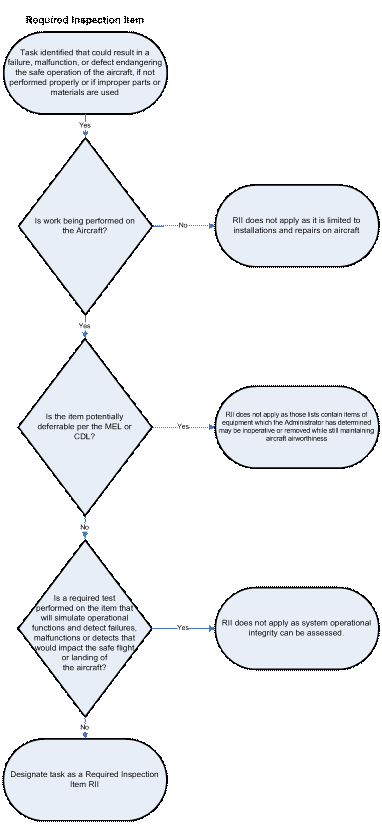
2) Making RII Lists. The air carrier must identify specific items of inspection for each aircraft type (it is inappropriate to designate entire systems as RIIs). The FAA recommends that the air carrier adhere to a decision process, similar to the recommended process shown in Figure 3-131B, Required Inspection Items (RII), when creating its list of RIIs.
NOTE: There is nothing preventing the air carrier from including additional items in its RII list that are not required by regulation and do not result from the recommended decision process in Figure 3-131B. However, the air carrier should consider and ensure that by doing so, it does not diminish the significance of an RII (additional inspection given to maintenance performed on a safety of flight item).
Figure 3‑142. Required Inspection Items (RII)
3) RIIs and Safety. The RIIs relate directly to flight safety. The air carrier should consider all of its RIIs with the same safety of flight consideration and emphasis even if accomplishing an individual RII adversely affects its flight schedule, relates to a scheduled or an unscheduled task, or arises at an awkward time or at an inconvenient location.
B. RII Procedures, Standards, and Limits.
1) List of Other Persons. The air carrier’s manual must include a list of persons with whom it has arranged for any required inspections (refer to §§ 121.369(a) and 135.427(a)) both within its organization and within other organizations that perform maintenance on the air carrier’s behalf. This listing must include a designation by occupational title of the personnel authorized to perform each required inspection (refer to §§ 121.369(b)(3) and 135.427(b)(3)).
2) Certification. With consideration of the exceptions at §§ 121.378(a) and 135.435(a), each individual that the air carrier grants an RII authorization to must hold an appropriate airman’s certificate. This is an air carrier qualification requirement; the individual does not exercise the authority and privileges of that certificate when accomplishing the RIIs. The air carrier must formally notify each of these individuals of their RII authorization as well as its scope (refer to §§ 121.371(d) and 135.429(e)).
3) RII Requirements. The air carrier should clearly identify its RII requirements on work forms, job cards, and engineering orders or by any other method consistent with its maintenance program. A primary concept of the RII function is to prevent any person who performs any item of work from performing any required inspection of that work (refer to §§ 121.369(b)(7) and 135.427(b)(7)). FAA policy includes any person who provides training to another person on the work performed. Therefore, it is important that the air carrier identify RIIs whenever possible so that everyone knows that an RII is required. The air carrier should also clearly state RII buy-back procedures (refer to §§ 121.369(b)(4) and 135.427(b)(4)).
4) Standards and Limitations. The air carrier must set procedures, standards, and limits necessary for required inspections and acceptance or rejection of the RIIs (refer to §§ 121.369(b)(5) and 135.427(b)(5)). The air carrier should have those procedures, standards, and limits necessary for the accomplishment of its required inspections. The air carrier must also have those procedures, standards, and limits necessary for the acceptance or rejection of each of its RIIs. As the air carrier will not find RIIs or procedures, standards, and limits for RIIs in an OEM manual, the air carrier will have to develop these and put them in its manual. The air carrier’s manual must specify the method of performing required inspections (refer to §§ 121.369(b)(3) and 135.427(b)(3)).
5) Procedures. The air carrier’s manual must include procedures to ensure that it performs and completes all required inspections (refer to §§ 121.369(b)(6) and 135.427(b)(6)) before it releases the aircraft to service (refer to §§ 121.369(b)(9) and 135.427(b)(9)).
3-3875 MAINTENANCE RECORDKEEPING SYSTEM.
NOTE: Additional information and policy on the air carrier maintenance recordkeeping system is contained in Volume 3, Chapter 31, Section 5 and Volume 3, Chapter 32, Section 1.
A. Reasons for Making and Keeping Maintenance Records. The air carrier’s primary reason to make and retain maintenance records is to show that the U.S. Standard Airworthiness Certificate on its aircraft is effective and that its aircraft is airworthy. The Airworthiness Certificate is effective on the air carrier’s aircraft only as long as the air carrier performs the maintenance and alterations according to the requirements of the FAA’s regulations. If the air carrier’s required aircraft maintenance records are incomplete or inaccurate, it can render its aircraft’s Airworthiness Certificate ineffective. Maintenance actions, in almost all cases, become intangible or abstract after the fact. Therefore, in order for the air carrier to make a maintenance action tangible, it must make a record of that maintenance action. Additionally, making a record of certain summary information supports identification of the current inspection and airworthiness status of the air carrier’s aircraft.

B. Part 43 Requirements. Section 43.9(a) contains the basic requirement to make a maintenance record; however, § 43.9(b) indicates that the governing requirements for an air carrier are found in part 121 or part 135. In other words, the recordkeeping requirements of part 43.9(a) do not apply to air carriers. However, the requirements of § 43.9(b) are consistent with the air carrier maintenance recordkeeping requirements of §§ 121.369(c) and 121.380(a) and (c), or §§ 135.427(c) and 135.439.
C. Work Performed by a Part 145 Repair Station.
1) Retaining Records. Section 145.219 requires a CRS to retain certain records of maintenance that it performs. It also requires the repair station to make those records available to the FAA. However, these §§ 43.9(a) and 145.219 requirements do not apply when the repair station is accomplishing any work on the air carrier’s aircraft.
2) Copies of Records. The wording of § 145.205 regulations as well as §§ 119.1(c), 121.1(b), and 135.1(a)(2) compel a part 145 CRS to follow the procedures and requirements of the air carrier’s maintenance program and applicable sections of its maintenance manual when accomplishing any maintenance or alterations on the air carrier’s aircraft. Consequently, a CRS must use the performance standards of part 121 or part 135, including the recordkeeping requirements, instead of following the provisions in part 145 and its repair station manual. This is consistent with the requirements of The Paperwork Reduction Act, which does not permit the government to require two separate but identical sets of records. The responsibility for retaining records in accordance with the retention requirements of §§ 121.380(c) and 135.439(b) rests with the air carrier, not the repair station. However, if a part 145 repair station wants to retain a copy of those records generated by working on the air carrier’s aircraft, FAA regulations do not preclude them from doing so. Asking the part 145 repair station to keep the air carrier’s records for the air carrier is consistent with regulations, although the air carrier is responsible for retaining them and making them available to the FAA. This is consistent with the requirements of § 119.59(c).

D. Penalties for Improper Air Carrier Maintenance Recordkeeping.
1) Importance of Maintenance Records. Maintenance records are important for:
a) The air carrier to fulfill its responsibility to determine the airworthiness status of its aircraft; and
b) The FAA to continue its review of aircraft maintenance records as a direct means of determining the airworthiness and safety status of air carrier aircraft.
2) Reviewing Maintenance Records. Because reviewing maintenance records is often the only direct means of determining the accomplishment of required maintenance, federal law treats the act of intentionally failing to make and keep, as well as the act of intentionally falsifying, mutilating, or altering, air carrier aircraft records as a criminal act, subject to the imposition of substantial fines and/or imprisonment.
E. Making and Keeping Required Records.
1) Recordkeeping System. FAA regulations (§ 121.369(c) or § 135.427(c)) require the air carrier to have and use a recordkeeping system for the preparation, storage, and retention of required aircraft maintenance records. The air carrier must document its system in its maintenance manual. The primary objectives of these systems are the generation, storage, retention, and retrieval of accurate and complete air carrier aircraft maintenance records. As stated earlier, the air carrier makes and retains these records to show the FAA that its aircraft have an effective U.S. Standard Airworthiness Certificate and are airworthy and capable of safe flight.
2) Record Locations. FAA regulations (i.e., § 119.59(b)(1)(ii)) also require the air carrier to make and keep a listing that identifies the location of each record, document, and report that the air carrier is required to make and keep, as well as a listing that identifies each person who is responsible for each of those records, documents, and reports.
3) ADs. FAA regulations §§ 121.380(a)(2)(vii) and 135.439(a)(2)(v) also require the air carrier to keep a record of the current status of applicable ADs, including the date and methods of compliance, and, if the AD involves recurring action, the time and date when the next action is required. Sections 121.369(c) and 135.427(c) require the air carrier to have and use a recordkeeping system for the preparation, storage, and retention of required aircraft maintenance records.
F. When to Make Records Available to the FAA. Section 119.59(c) mandates that the air carrier must make its required maintenance records available to the FAA at any time when the FAA requires them.
G. Responsibility for Making Records Available to the FAA. Under § 119.59(b)(1)(ii), the air carrier must make a list of persons in its organization that it has designated to be responsible for making each required maintenance record, document, or report available to the FAA upon request. The air carrier must make a list of the location of each record, document, or report. The air carrier must keep this list current and make it available to the FAA at its principal base of operations.

H. Required Records. The air carrier is required to make and keep certain current status records. Sections 121.380 and 135.439 list current status recordkeeping requirements, which are explained as follows:
1) Total Time in Service. The total time in service of the airframe, each installed engine, and each installed propeller is a record that contains the time in service accrued since new or rebuilt, expressed in hours, landings, or cycles.
NOTE: It is important for the inspector and the air carrier to know that “rebuilt” does not have the same meaning as “overhauled” (see § 43.2(b)).
2) Current Status of Each Life-Limited Part. The current status of each life-limited part of each airframe, engine, propeller, and appliance means a record that contains at least the following information:
a) Time in service since new, expressed in the appropriate parameter (e.g., hours, cycles, or calendar‑time);
b) The time in service remaining to the specified life limit expressed in the appropriate parameter (e.g., hours, cycles, or calendar-time);
c) The specified life limit expressed in the appropriate parameter (e.g., hours, cycles, or calendar‑time); and
d) A record of any action that alters the part’s life limit or changes the parameter of the life limit.
NOTE: If the air carrier conducts operations under part 135, total time in service and the current status of life-limited parts also includes rotors.
3) Time Since Last Overhaul. The listing of the time since last overhaul means a record that contains at least the following information:
a) An identification of the item that requires overhaul and its associated scheduled overhaul interval;
b) The time in service since the last overhaul was accomplished;

c) The time in service remaining until the next scheduled overhaul is due; and
d) The time in service when the next scheduled overhaul is due.
NOTE: The listing of time since last overhaul refers to summary current status information. The air carrier must not confuse it with an overhaul record, which is a description of the work performed and the identification of the person who performed and/or issued the approval for return to service.
4) Current Inspection Status of the Aircraft. The current inspection status of the aircraft means a record that contains at least the following information:

a) A listing identifying each of the scheduled inspection packages, each task, and their associated intervals required by the aircraft’s maintenance program;
b) The time in service accrued since the last accomplishment of each of the scheduled inspection packages and tasks required by the aircraft’s maintenance program;
c) The time in service remaining until the next accomplishment of each of the scheduled inspection packages and tasks required by the aircraft’s maintenance program; and
d) The time in service when the next accomplishment of each of the scheduled inspection packages and tasks required by the aircraft’s maintenance program is due.
5) Current Status of Applicable AD. The current status of applicable ADs means a record that contains at least the following information:
a) Identification of the particular airframe, engine, propeller, appliance, or component to which the AD applies.
b) The AD number (and/or regulatory amendment number).
c) The date when a person accomplishes the required action and the time in service expressed in the appropriate parameter (e.g., hours, cycles, and calendar-time).
d) If the requirement is recurring, the date when the next action is due, and the time in service expressed in the appropriate parameter (e.g., hours, cycles, and calendar-time).
e) With regard to an AD, the method of compliance means a concise description of the action taken to comply with the requirements of the AD. If the AD or its referenced manufacturer’s Service Bulletin (SB) permits the use of more than one method of compliance, the record must include a reference to the specific method of compliance used. If the air carrier uses an AMOC to comply with an AD, the method of compliance means a description of the AMOC and a copy of the FAA approval.
NOTE: The air carrier should not confuse the current status listing of an AD or method of compliance with an AD record of accomplishment, which is a description of the work and who performed it and/or issued the approval for return to service. They are two separate and distinct records.
6) Current Major Alterations of Each Airframe, Engine, Propeller, and Appliance. A “listing” means a record that contains at least the following information:
a) A listing identifying each major alteration, as well as the associated item that has been altered; and
b) A description of, or reference to, the FAA-approved technical data that the air carrier used to make the major alteration.
NOTE: If the air carrier conducts operations under part 135, this listing must include all current major repairs, as well as major alterations, and it must include major repairs and major alterations to each rotor.
NOTE: The listing of the current major alterations in § 121.380(a)(2)(vii) refers to summary current status information record. The air carrier must not confuse this with a major alteration report required by § 121.707, which is a description of the work performed, a description of the FAA-approved technical data used to make the major alteration, and the identification of the individual who performed and/or issued the approval for return to service. The air carrier must not confuse this listing with the requirement to submit a copy of each report of a major alteration to the FAA. There are two different requirements: one for a major alteration current status listing, and one for a report for each major alteration that the air carrier accomplishes.
7) Airworthiness Release Form. All the records necessary to show that the air carrier has met all requirements for the issuance of an Airworthiness Release Form support the use of an Airworthiness Release Form, which is not part of the aircraft maintenance logbook. While the regulatory requirement for these records does not provide a detailed list of these records, the FAA generally accepts this requirement to mean:

a) Detailed records of all scheduled maintenance that has not been superseded by work of equivalent scope and detail;
b) Detailed records of the last overhaul for items that required an overhaul;
c) Detailed records of all unscheduled maintenance that has not been superseded by work of equivalent scope and detail; and
d) Copies of the Airworthiness Release Form covering the last 60 days of operation.
I. Other Required Records and Reports. The FAA regulations require the air carrier to make other reports and records as discussed in this subparagraph. The air carrier can use these records and reports to review its maintenance operations to determine the adequacy of the maintenance portion of its air carrier manual and the effectiveness of its maintenance program elements. These records are one of the sources of information for the air carrier’s CASS. The FAA also uses these reports in its continuous oversight of the air carrier’s maintenance program activities.
1) Maintenance Log. Sections 121.701 and 135.65 require any person who takes action in response to a reported or observed failure or malfunction to make a record of that action in the maintenance log of the aircraft. These air carrier maintenance log entries correspond to the maintenance recording requirements of § 43.9(b). The air carrier also must ensure that each pilot in command (PIC) ensures that all mechanical irregularities occurring during flight time are entered in the maintenance log at the end of that particular flight time, consistent with §§ 121.563 and 135.65.
2) Airworthiness Release Form or Log Entry.
a) The air carrier’s Airworthiness Release Form or Log Entry required by § 121.709 or § 135.443 corresponds to the approval for return to service requirements of §§ 43.5, 43.7(e), 121.379(b), and 135.437(b). Furthermore, parts 121 and 135 require the air carrier to prepare either an Airworthiness Release Form or Log Entry before it can operate its aircraft after it performs any maintenance, preventive maintenance, or alterations, whether it operates the aircraft in air transportation or not.
b) The air carrier’s approval for return to service certification and documentation required by § 121.709 or § 135.443 is a singular requirement, but the air carrier may execute it in one of two ways:
1. The air carrier may complete an Airworthiness Release Form and give it to the PIC. If the air carrier uses an Airworthiness Release Form, it must keep it separate and distinct from the aircraft log. It is not included in the maintenance recordkeeping requirements. The separate and distinct requirement corresponds to the requirements in §§ 121.380(a)(1) and 121.709(d). In modern day environments, air carriers are most likely to use the log entry method to comply with § 121.709 or § 135.443. Other than form or format, there is no legal or technical difference between an Airworthiness Release Form and a Log Entry.
2. If the air carrier makes a Log Entry, it does not have to issue an Airworthiness Release Form. To avoid confusion and to be consistent with the regulations, the air carrier should not identify this entry in the aircraft log as an airworthiness release. The FAA understands that few air carriers use a separate Airworthiness Release Form.
c) Consistent with §§ 121.709(d) and 135.443(d), the air carrier may include a statement in its manual that the signature of an authorized, appropriately certificated individual in the aircraft log constitutes an approval for return to service under the air carrier’s maintenance program. The authorized signature constitutes the four certification statements in §§ 121.709(b)(2) and 135.443(b)(2) without restating each one of them. If the air carrier has this provision stated in its manual, it is very important it maintains control for its use. The air carrier must prepare its Airworthiness Release Form or Log Entry in accordance with procedures in its manual and must include the following four certifications consistent with statutory considerations for operations with the highest degree of safety in the public interest.
1. The work was performed in accordance with the requirements of the air carrier’s manual;
2. All items required to be inspected were inspected by an authorized person who determined the work was satisfactorily completed;
3. No known condition exists that would make the aircraft non-airworthy; and
4. So far as the work performed is concerned, the aircraft is in condition for safe operation.
d) An appropriately certificated individual who the air carrier authorizes to make the Airworthiness Release Form or Log Entry on its behalf must sign the Airworthiness Release Form or Log Entry.

NOTE: An authorized mechanic or repairman on the air carrier’s behalf under its part 121 or part 135 certificate authorizations must sign the Airworthiness Release Form or Log Entry. This is consistent with the requirements and authorizations of § 43.7(e), § 121.379(b), or § 135.437(b), and § 121.709(b)(3) or § 135.443(b)(3).
NOTE: Consistent with regulations, no individual may issue an Airworthiness Release Form or make a maintenance Log Entry unless the air carrier has authorized them.
NOTE: Because a part 145 repair station is not an individual, these same regulations preclude accomplishment of the air carrier’s Airworthiness Release Form or Log Entry by a part 145 CRS. With one exception, an authorized, certificated individual (as described in §§ 121.709 and 135.443) must execute the Airworthiness Release Form or Log Entry according to the air carrier’s procedures. The repair station may employ the authorized individual, but they are acting on the air carrier’s behalf, not on behalf of the repair station. This is consistent with §§ 119.1(c) and 121.1(b) or § 135.1(a)(2).
e) The air carrier’s maintenance manual should include detailed procedures for accomplishing the Airworthiness Release Form or Log Entry after it accomplishes any maintenance on its aircraft. The air carrier’s procedures should include controls designed to ensure that it does not operate its aircraft after it accomplishes any maintenance, preventive maintenance, or alteration unless it completes the Airworthiness Release Form or maintenance Log Entry.

f) The air carrier’s maintenance manual should include detailed procedures for qualifying and authorizing each individual that it uses to accomplish its § 121.709 or § 135.443 Airworthiness Release Form or Log Entry. These procedures should include a positive, readily available means for the air carrier to document and transmit the authorization to the individual, including the scope and limitations of their authorization.
3) Service Difficulty Reports (SDR). (Also see Volume 8, Chapter 5, Section 6.) The air carrier is required to make SDRs in accordance with §§ 121.703 and 135.415. While analysis of these reports can help the air carrier to identify deficiencies within its maintenance program, these reports are also the FAA’s primary means of gathering information for their SDRs.
4) Mechanical Interruption Summary Reports (MISR). (Also see Volume 3, Chapter 32, Section 14.) Sections 121.705 and 135.417 require air carriers to make MISRs. These reports document the inability of the air carrier’s aircraft to arrive at its scheduled destination because of mechanical difficulties. This is a prime indicator of deficiencies in the effectiveness of the air carrier’s maintenance program. Moreover, root cause analysis of these events is one of the air carrier’s most useful means of oversight of the level of effectiveness of its maintenance program.


J. Requirements for Reports of Major Alterations and Major Repairs.
1) Part 121 Major Repair and Major Alteration Reports. If the air carrier conducts operations under part 121, § 121.707 requires it to make a report of each major alteration and major repair. The air carrier must submit the major alteration report and make the major repair report available to the FAA for inspection. This falls under § 119.59 requirements. Air carriers do not have to use FAA Form 337, Major Repair and Alteration (Airframe, Powerplant, Propeller, or Appliance), to report a major alteration or major repair that the air carrier or maintenance provider accomplished.
2) Part 135 Major Repair and Major Alteration Reports. If the air carrier conducts operations under part 135, there is no requirement that requires it to submit reports of major alterations or major repairs. However, while a report is not required, the records of aircraft maintenance or alteration are required and the air carrier must make them available to the FAA when requested.
NOTE: The air carrier should not confuse these alteration and repair reports with the current status listing of major alterations required under part 121 or the current status listing of major repairs and alterations required under part 135.
K. Requirements for Historical or Source Records. The air carrier does not have to keep historical or source records to prove that the required records (e.g., current status records §§ 121.380 and 135.439) that it must make, keep, and make available to the FAA are true and accurate. Inherent with the requirements and objectives of an air carrier maintenance program, the air carrier must have a system to prepare, store, and retain its required maintenance records; it must monitor that system under its CASS to ensure that it is following its procedures and that they are effective. This ensures that the air carrier’s required records are true and accurate. The air carrier does not need to indefinitely keep records such as the in-service history of life-limited parts (traceability back to birth) or the accomplishment of an AD. However, remember that there are severe criminal penalties for falsifying or failing to make or keep air carrier records.

1) Acceptable Records. Consistent with the FAA regulations, unless there is evidence to the contrary, an aircraft maintenance record produced by the air carrier’s maintenance recordkeeping system should be acceptable by itself, without other historical or source records. The important consideration here is that the air carrier has a sound and properly working recordkeeping system. The air carrier may wish to archive certain source documentation records that it used to introduce parts or components into its maintenance system. These records may include documents such as the manufacturer’s invoice for new parts, export certificates of airworthiness, documentation of a major repair or alteration, or other similar information that may be useful in the future. The air carrier may also have business reasons to maintain historical records or may do so of its own choice. The air carrier is only legally required to make, retain, and produce for FAA review those records clearly outlined in 14 CFR.

3-3876 CONTRACT MAINTENANCE. Also see Volume 3, Chapter 42, Section 1.
A. Maintenance Providers. This section uses the following two standardized terms to prevent confusion related to the meaning of various terms such as contract maintenance, outsource maintenance, outsource contract maintenance, outsource maintenance provider, and substantial maintenance.
· Contract maintenance. Contract maintenance means any maintenance, preventive maintenance, or alterations accomplished by an air carrier maintenance provider.
· Air carrier maintenance provider or maintenance provider. Air carrier maintenance provider or maintenance provider means any person with whom the air carrier has made arrangements for the accomplishment of any of its maintenance, preventive maintenance, or alterations.
1) Essential Maintenance (Part 121 Only). Essential maintenance encompasses any on-wing RII accomplished after any maintenance or alteration. This maintenance, if completed improperly or if improper parts or materials were used, would result in a failure effect that would endanger the continued safe flight and landing of the airplane. Essential maintenance is the accomplishment of the air carrier designated on-wing inspection item. Essential maintenance does not encompass any off-wing maintenance.
2) Maintenance Provider List. Maintenance manual regulations require the air carrier to list in its manual each person it arranges for the performance of maintenance, preventive maintenance, and alterations. This requirement applies to all maintenance providers that the air carrier has (directly) arranged for the performance of maintenance, preventive maintenance, and alterations such as a repair station. It does not apply to persons that perform contract maintenance for the repair station under § 145.217. This policy only applies to the list required by §§ 121.369(a) and 135.427(a). It does not apply to any other regulation which contains any form of the word “arrange.” This policy does not relieve the air carrier from its responsibilities for the performance of all maintenance and the airworthiness of its aircraft, regardless of who is or is not listed in its manual. The air carrier must demonstrate to the PI how it will provide the name, location, and type of maintenance a repair station contractor performs when requested by the inspector. There must never be a situation where the air carrier does not know who is performing maintenance for it, including repair station contractors. The regulations also require the air carrier to identify each of its maintenance providers by name, location, and a general description of the work they perform. The FAA recommends that the air carrier identify the description of work for its maintenance providers using the following five categories. If the air carrier operates more than one type of aircraft, the categories should include the type of aircraft. For the fourth and fifth categories, the air carrier should include the type of specialized service or the kind of component, as appropriate. The air carrier uses these lists for its CASS functions and should have that level of detail needed by the air carrier’s maintenance provider surveillance and audit planning functions.
a) Aircraft maintenance.
1. Heavy maintenance.
2. Line maintenance.
b) Aircraft engine work.
c) Propeller work.
d) Component work.

e) Specialized service.
3) Essential Maintenance Provider List. The air carrier should have a means to identify, within its maintenance provider list, those maintenance providers who accomplish essential maintenance for it. The air carrier should also identify the specific required inspection that it has authorized each essential maintenance provider to accomplish for it in its maintenance provider list.
B. Responsibility for Maintenance Performed by Others.
1) Air Carrier Maintenance. Consistent with §§ 121.1(b) and 135.1(a)(2) and other sections, when the air carrier uses a maintenance provider to accomplish all or part of the maintenance activities on its airplane or its component parts, that maintenance provider becomes part of the air carrier’s maintenance organization and under the air carrier’s control. However, §§ 121.363 and 135.413 make it clear that the air carrier remains primarily responsible for all of the maintenance performed by that maintenance provider on its aircraft. The air carrier must determine that the maintenance provider has the capability to do the air carrier’s work on its behalf, manage its work, and determine that it does the work satisfactorily according to the air carrier’s manual and standards. Because the maintenance provider must perform all work on the air carrier’s aircraft in accordance with the air carrier’s maintenance manual and its maintenance program, the air carrier must also provide the maintenance provider with appropriate material from its maintenance manual for that work.
2) Air Carrier Policy and Procedures. The air carrier must ensure that the maintenance provider follows the procedures in the air carrier’s manual that it has provided. The air carrier should accomplish this through work-in-progress audits while the maintenance provider is actually accomplishing the work. The air carrier’s manual system should accommodate work performed for it by each maintenance provider. The policy and procedures portion of the air carrier’s maintenance manual should assign clear authority and responsibilities and outline procedures for its personnel to administer, control, and direct all contract maintenance. The air carrier should arrange the technical material that it provides for the use and guidance of the maintenance provider.
3) Contract Maintenance. When possible, the air carrier should have a written contract with anyone performing contract maintenance for it on a continuing basis. This will help ensure that the maintenance provider addresses the air carrier’s responsibilities. In the case of major operations, such as engine, propeller, or airframe overhaul, the contract should include a specification for the work. The air carrier should include or reference that specification in its manual system.
C. Unscheduled Maintenance Performed Away from Regular Facilities. Sometimes, the air carrier will need maintenance performed on its aircraft while it is away from its regular maintenance facilities. The air carrier also may need maintenance services on short notice. The air carrier’s maintenance manual should include procedures for obtaining these services under these unanticipated conditions. The air carrier should never use the term “emergency maintenance” to describe short notice unscheduled maintenance, as such terms imply to the air carrier’s employees and its maintenance providers that FAA regulations and the air carrier’s procedures do not have to be followed. Emergency means that a serious situation has occurred unexpectedly, involves a peril to life or property, and demands immediate action. An out-of-commission aircraft parked on an airport ramp could hardly constitute a peril to life or property. The air carrier should outline the procedural steps that it will take to control and direct the unscheduled maintenance accomplished by its maintenance provider. Unscheduled, short-notice requirements for maintenance do not void the air carrier’s responsibility to determine that its maintenance provider has the organization, adequate facilities and equipment, competent personnel, and appropriate portions of the air carrier’s manual for the work the maintenance provider needs to complete. The air carrier must make these determinations before any maintenance provider starts to work on its aircraft. These procedures and method of determination should be in the air carrier’s manual.


D. Airworthiness Release Form or Aircraft Log Entry. Sections 121.379(b) and 135.437(b) authorize the air carrier to approve its aircraft, airframes, aircraft engines, propellers, or appliances for return to service after it accomplishes any maintenance, preventive maintenance, and alterations. These sections do not authorize any person other than the air carrier to approve its aircraft for return to service. Sections 121.709(b) and 135.443(b) outline requirements for those personnel making a Log Entry or issuing an air carrier Airworthiness Release Form under part 121 or part 135 on the air carrier’s behalf. These regulations require a certificated repairman, or certificated A&P mechanic that the air carrier authorizes, to make the Log Entry or issue the Airworthiness Release Form for the air carrier. These regulations clearly do not authorize a repair station certificated under part 145 or any other entity to make an Airworthiness Release Form or Log Entry on the air carrier’s behalf. The regulations set forth clear personnel qualification requirements for each individual the air carrier so authorizes. The approval for return to service authority remains solely with the air carrier. An individual may not issue an approval for return to service for the air carrier’s aircraft unless the air carrier authorizes them to do so.
1) Log Entry or Airworthiness Release Form. The air carrier must designate each individual authorized to execute the Log Entry or Airworthiness Release Form for it by name and occupational title. The individual making the Log Entry or Airworthiness Release Form acts as the air carrier’s authorized agent. He or she certifies that they accomplished the maintenance according to the air carrier’s maintenance manual and maintenance program procedures and that no known condition exists that would make the aircraft non-airworthy. This arrangement does not reduce the responsibility of maintenance personnel to accomplish maintenance functions or tasks in accordance with the air carrier’s manual.

2) Procedures for Log Entry or Airworthiness Release Form. Consistent with §§ 121.709(b)(1) and 135.443(b)(1), the air carrier’s maintenance manual must include the procedures for making an aircraft Airworthiness Release Form or Log Entry. Our regulations require the air carrier to make a Log Entry or complete an Airworthiness Release Form before it can operate its aircraft for any reason after the air carrier has accomplished any maintenance. The air carrier is required to make a Log Entry or an Airworthiness Release. Other than form or format, there is no legal or technical difference between an Airworthiness Release Form and a Log Entry.
E. Evaluating New Contract Maintenance Providers. Before the air carrier can use a maintenance provider for the first time, it must determine that the maintenance provider candidate complies with pertinent requirements of part 121 subpart L or part 135 subpart J. In most cases, the air carrier would conduct an onsite audit. The air carrier must demonstrate, through this audit or by some other means, that the maintenance provider has an adequate organization, adequate facilities and equipment, and competent personnel, and is capable of performing the work consistent with the requirements of the air carrier’s program. The air carrier should use a risk assessment process to determine whether or not to accomplish an onsite audit. The air carrier’s risk assessment should take into account what happens (the failure effect) when the aircraft part or aircraft system that the maintenance provider works on fails. If the failure effect is safety, the air carrier procedures should mandate an initial onsite audit along with recurrent onsite audits, as well as the posting of an employee who is assigned audit and oversight duties as resident at the maintenance provider’s facility.

NOTE: Since the failure effect of parts and systems that come under essential maintenance relates to safety, the FAA expects the air carrier to have policies and procedures to qualify, supervise, and control these maintenance providers, which should include onsite audits.
F. Continuing Maintenance Provider Oversight. Ensuring that each one of the air carrier’s maintenance providers is in continuous compliance is a major function of the certificate holder’s CASS. The air carrier should use its risk-based process for establishing a schedule for auditing and inspecting each of its maintenance providers. Inherent with a risk-based process, the air carrier may determine that some of its maintenance providers do not require an onsite audit. Consistent with the “performance” wording of § 121.373 or § 135.431, the audits that the air carrier accomplishes should be primarily work-in-progress audits that serve to determine that the air carrier’s maintenance providers are following the air carrier’s manual. The audits should be accomplished by trained auditors, and the results analyzed by trained analysts. The results of the analysis should permit the air carrier to determine each maintenance provider’s continuing compliance with part 121 subpart L or part 135 subpart J, as appropriate, and the air carrier’s maintenance program.
G. Using a CRS as One of the Air Carrier’s Maintenance Providers.
1) Repair Stations. If the air carrier decides to exercise its authority under § 121.379 or § 135.437 to make arrangements with other persons to accomplish contract maintenance for it as provided in its manual, the air carrier may choose to make these arrangements with an FAA-CRS, but these rules do not require the air carrier to do so. The scope of the air carrier’s authorization to make arrangements for maintenance is very broad; it can make arrangements for maintenance with any “person” as that term is defined in 14 CFR part 1, § 1.1 as long as that maintenance provider accomplishes the air carrier’s maintenance in accordance with its manual and maintenance program. Although the § 1.1 term “person” includes a CRS, it also includes anyone who does not hold an FAA certification.

2) Regulatory Requirements. The requirements that the air carrier uses to qualify a maintenance provider that holds a current part 145 repair station certificate and a maintenance provider who does not hold a current part 145 repair station certificate should be exactly the same. Consistent with § 119.1(c), § 121.1(b), or § 135.1(a)(2), each person, whether certificated or not, that is employed or used by the air carrier for any maintenance, preventative maintenance, or alteration of the air carrier’s aircraft is required to comply with the part 121 requirements and the air carrier’s maintenance program requirements, not part 65 or 145 requirements.
3) Approval for Return to Service. The air carrier’s § 121.379(b) or § 135.437(b) authorization to approve its aircraft for return to service after maintenance extends to the work accomplished under its § 121.379(a) or § 135.437(a) authorization to make arrangements with other persons for maintenance.
3-3877 PERSONNEL TRAINING. Also see Volume 3, Chapter 24, Sections 1 and 2.
A. Maintenance Program Training Requirements. Certain sections of part 121 subpart L and part 135 subpart J contain specific air carrier maintenance training requirements. Sections 121.375 and 135.433 require the air carrier to have a training program that ensures it informs each person (including inspection personnel) who determines the adequacy of work completed for the air carrier about procedures, techniques, and new equipment in use and that each person is competent to perform his or her duties. There is an additional implied training requirement in part 121 subpart L and part 135 subpart J based on the air carrier’s responsibility to provide competent personnel for the proper performance of its maintenance program. A training program is the logical means for ensuring maintenance personnel are competent. FAA regulations allow the air carrier to develop a training program that fits its particular needs.

B. Types of Training. Some of the possible types of training in the air carrier’s training program are initial training, recurrent training, specialized training, competency-based training, and maintenance provider training. The air carrier should select the appropriate training for its personnel, including its maintenance provider personnel, which the air carrier should base on an assessment of training needs. This assessment is a reflection of the required knowledge, skills, and ability to accomplish a given task or function properly and the current capability of those whom the air carrier would assign a particular task or function.
C. Initial Training. The air carrier should provide initial training right after it hires an employee, when its existing employees begin to work on new equipment, or when the air carrier gives the employee a new assignment. The air carrier’s initial training program may include subjects such as:
· Employee indoctrination or orientation,
· Maintenance department policies and procedures,
· Maintenance recordkeeping and documentation,
· Aircraft systems or ground equipment,
· Specific skills (e.g., avionics, composite repair, aircraft run-up and taxi),
· Skills upgrade,
· Human factors,
· Task-specific training,
· Hazardous materials (hazmats) or Environmental Protection Agency (EPA) regulations, and
· Occupational Safety and Health Administration (OSHA) regulations familiarization.
NOTE: The air carrier’s initial training should also include a competence-based assessment of employees. This evaluates an employee’s previous training and experience and helps identify his or her specific individual training needs. The objective is to provide training that addresses the gap between required competence and the competence an individual already has.
D. Recurrent Training. Recurrent training is education occurring on a repetitive basis. The air carrier must provide maintenance personnel with the information and skills necessary to maintain its standard of competence. This training also accommodates the introduction of new aircraft; aircraft modifications; new or different ground equipment; new procedures, techniques, and methods; or other new information. The air carrier’s recurrent training, although occurring on a repetitive basis, may not adhere to a defined schedule. The air carrier should not provide repetitive information in recurrent training unless it is required to maintain personnel at a desired degree of competence. The air carrier’s recurrent training may include:
· Continuing competency training designed to maintain regulatory and certificate currency requirements.
· Refresher training on a seldom-accomplished task or seldom-used skill.
· Update training for particular tasks or skills. Update training can include training bulletins, bulletin-board items, self-study tasks, and computer-based instruction (CBI).
· Any other continuing education or training that it may not provide on a defined schedule.
E. Specialized Training. The air carrier’s specialized training should focus on competence in specific tasks or areas of responsibility, such as RII, borescope, nondestructive testing, or flight control rigging. The air carrier might provide this training with initial or recurrent training. The air carrier does not need to limit it to maintenance subjects, but instead may include management skills training for new supervisors, computer skills, or other training necessary because of a change in an individual’s duties and responsibilities.

F. Maintenance Provider Training. The air carrier’s training program must provide appropriate information to each employee of a maintenance provider about its specific program. The training should include function-specific training appropriate to each person’s job assignment or area of responsibility. The air carrier does not need to provide training to maintenance provider personnel in areas that do not concern them. For example, training on aircraft log procedures and minimum equipment list (MEL) procedures would not be required for aircraft interior cleaners, but would be required for maintenance personnel assigned to oncall maintenance for the air carrier.
NOTE: If the air carrier’s maintenance provider has specific types of training for its personnel, the air carrier does not need to duplicate that training for those individuals. However, the air carrier must ensure that its maintenance provider has actually provided the training and that the training meets the air carrier’s own needs and training standards. This could be a CASS work-in-progress audit.
G. Competency-Based Training. Although air carriers historically have provided a specified number of maintenance training hours to ensure that employees have the competencies needed for their jobs, studies have shown that it may be better for the air carrier to train to a competency-based standard. The air carrier does not have to perform this type of training on a defined schedule or for a specific number of hours. Rather, the air carrier should test each individual to evaluate what training he or she needs, and then use these evaluations to identify those personnel who retain a high level of subject competence and who may not require a particular block of instruction. Conversely, the air carrier should also identify those individuals who require more training. Training to a competence level permits the air carrier to tailor training programs to the specific requirements of the air carrier’s individual maintenance personnel and maintenance providers.
1) When to Require Competency-Based Training. The air carrier could use competency-based training to raise an employee’s level of competence to that level required by the individual’s duties and responsibilities. The air carrier should have procedures to determine when an individual requires competency-based training. The air carrier may determine the need for this type of training through pre-or post-employment testing, or through the analysis and corrective action functions of its CASS. If the air carrier uses competency-based training, it should specifically address the lack of competence. In some instances, competency-based training may consist of an appropriately knowledgeable person simply reviewing procedures with an employee through on-the-job training (OJT). The air carrier should design competency-based training to fix an immediate knowledge or skill deficiency and the training may focus on one individual or a small group. The air carrier may include competency-based training in its initial or recurrent training requirements.

2) Competency Deficiencies. For those circumstances where the air carrier identifies a competency deficiency through investigation of an event, the air carrier’s competency-based training should show an individual what happened, why it happened, and demonstrate, in a positive manner, how to prevent it from happening again.

3) Competency Improvement Training. The air carrier should orient its competency improvement training toward correcting personnel competence deficiencies that the air carrier has identified through its CASS.
3-3878 CASS. Also see Volume 3, Chapter 44, Section 1 and Volume 3, Chapter 49, Section 1.
A. Background of the CASS. Introduction of the CASS requirement resulted from an FAA industry study of a series of maintenance-related air carrier accidents occurring during the 1950s. The study found that, in many cases, the primary causal factor of an accident was a fundamental weakness or weaknesses in the air carrier maintenance program. The study found that, in some cases, maintenance personnel did not follow the manual and failed to accomplish required maintenance tasks or failed to accomplish the task correctly. In other cases, the study found that the maintenance program, even when followed as planned and documented, was not effective in preventing the situation that led to the accident. It did not produce the desired results.
1) Regulations. Responding to this finding, the FAA introduced regulations (§§ 121.373 and 135.431) that require the air carrier to establish and maintain a system for the continuing analysis and surveillance of the performance and effectiveness of its maintenance program.
2) Correcting Deficiencies. These regulations further require that the air carrier include a process in its CASS to correct any deficiency identified in its maintenance program, regardless of whether the air carrier did the work or had a maintenance provider do the work.

B. CASS is a Safety Management Tool. A CASS is the air carrier’s system for managing safety as it relates to maintenance functions. As a tool to manage safety, it is part of the overall structure of policies and procedures that the air carrier uses to ensure its operations are to the highest possible degree of safety. It is a structured, methodical process that helps the air carrier reach its maintenance program objectives. CASS is the only management system mandated by regulation. If the air carrier uses it properly, its CASS becomes an inherent way of doing business for it and helps the air carrier to promote a culture of safety in its company by providing a formal process for its employees to identify and correct safety deficiencies. The objectives of measuring and continuously improving the performance (program execution) and effectiveness (program results) of a major function (maintenance) apply equally to all safety-related maintenance program functions that the air carrier must manage.
C. Basic CASS Processes.
1) CASS Processes. The air carrier’s CASS is a risk-based, closed-loop system that has four basic processes:
a) Surveillance. An information gathering/audit process the air carrier uses to collect data to measure the air carrier’s program execution and results.
b) Analysis. An analysis process the air carrier uses to identify any maintenance program deficiencies and any necessary corrective actions.
c) Corrective Action. A planning process the air carrier uses to ensure that it implements its corrective actions.
d) Followup. A performance measurement process that the air carrier uses to verify that its corrective actions are effective. This is also an information-gathering and analysis process, thereby closing the loop.
2) Using an Audit Program. During the first step (surveillance) the air carrier will gather and obtain data using an audit program to support measurement of performance (program execution). The air carrier should have a well-structured audit program based on risk assessment and accomplished by individuals trained and skilled specifically at auditing. Consistent with the wording of the regulation, the air carrier’s primary type of audit should be work-in-progress audits that evaluate if the worker is following the manual. The air carrier’s auditors would also look at areas such as manuals and other maintenance technical data, aircraft condition, actual in-process maintenance practices, training, publications, and ground operations. In addition, information-gathering to obtain data that will support the measurement of effectiveness (program results) is generally a collection of flight operational data such as accidents/incidents, mechanical delays and cancellations, in-flight engine shutdowns, unscheduled landings, engine performance, pilot logbook write-ups, and unconfirmed components or parts removals.
3) Data Analysis. In the second step, the air carrier will analyze the data to identify indications of maintenance program weaknesses. Individuals experienced and/or trained as analysts should accomplish the air carrier’s data analysis. One of the air carrier’s key objectives here is not only to identify a weakness, but also to determine its root cause. This is where the air carrier’s knowledge of human factors becomes critical.
4) Developing Corrective Action. Based on the results of the air carrier’s analysis, the third step is for the air carrier to develop a corrective action, if necessary, taking human factors into account so that its corrective action is likely to be successful. Once the air carrier determines what the corrective action is, it will develop and implement a corrective action plan.
5) Conduct a Followup Measurement Process. To close the loop, the fourth step of the air carrier’s CASS will have the air carrier conduct a followup measurement process using surveillance and analysis to verify that its corrective action has effectively corrected the deficiency that it identified. The air carrier can design this followup data‑gathering process specifically for the issue of interest, or it can make it a part of its continuing surveillance that is the first step of its CASS. Determining if the air carrier needs a special information-gathering procedure is part of its analysis that it accomplished in step three.

6) Aspects of Surveillance. Both the initial and followup surveillance can and should have proactive and reactive aspects to them. In the case of audits by auditing systems and procedures, as well as specific transactions, the analysis of audit results can identify weaknesses in a process. Correcting these weaknesses before a problem results is a proactive approach. An audit also may uncover a missed or improper maintenance action. Investigating this finding and correcting the immediate problem is a reactive process. Developing and implementing a corrective action to prevent a similar future event is equally important for improving the maintenance program, and the regulations require it. Similarly, the air carrier’s analysis of operational performance data from a systems point of view can result in identification of a system’s weakness before a specific unwanted event (such as a cancellation) occurs, which is a proactive process. Investigating and correcting an undesirable operational event related to the maintenance program after it has occurred, though reactive, also is a necessary and desirable procedure.
D. Risk-Based Decisions. All effective CASSs take into account the need to manage risk to an acceptable level, as well as the practical limitations that the air carrier must face when addressing deficiencies. Consequently, the air carrier must set priorities and make choices for planning audits and other information-gathering activities, analyzing data, and selecting and implementing corrective actions. The air carrier should tie setting such priorities directly to a risk assessment process, so that the resulting maintenance program achieves its objectives.
E. Scope of CASS. CASS monitors all 10 elements of the air carrier’s maintenance program:
· Airworthiness responsibility,
· Air carrier maintenance manual,
· Air carrier maintenance organization,
· Accomplishment and approval of maintenance and alterations,
· Maintenance schedule,
· RIIs,
· Maintenance recordkeeping system,
· Contract maintenance,
· Personnel training, and
· CASS.

F. CASS Design Principles.
1) Attributes of System Safety.
· Clear authority,
· Clear responsibility,
· Specific written procedures,
· Effective controls,
· Performance measures, and
· Well-defined interfaces.
2) CASS Design. These six system safety attributes should be the starting point for the design of the air carrier’s CASS. It should be clear who in the air carrier’s organization is responsible for and has authority over the CASS. The air carrier should not divide responsibility/authority into two or more parts due to the likely possibility that activity such as auditing and operations data analysis are poorly coordinated. Typically, in addition to an individual with overall CASS responsibility, the air carrier should have a management board or committee to ensure good communications and coordination of all CASS functions and to maintain regular senior level management involvement. This oversight group also can provide a form of control over critical aspects of the air carrier’s CASS operation and measure the performance and effectiveness of the CASS itself.
3) CASS Interfaces. In addition to the many elements within the air carrier’s maintenance organization, there are many interfaces between the CASS and functions or organizational elements of a typical air carrier that are outside maintenance. Some of the more obvious examples are engineering, flight operations, purchasing, safety, and the FAA. It is also important that the air carrier defines and coordinates its CASS relationships to its other programs (if they exist) well, such as internal evaluation programs, flight operations quality assurance (FOQA) programs, voluntary disclosures, and Aviation Safety Action Programs (ASAP).
G. CASS Personnel Requirements.
1) Effective CASS Skills. An effective CASS requires certain skills that the air carrier may not have readily available within its maintenance organization. For example, auditing skills are not automatically inherent in those skilled in accomplishing maintenance. Analysis skills, particularly those related to root cause determination, risk analysis, and human factors, are specialized skills and generally require specific training and experience.

2) Sharing Personnel. All operators, but particularly smaller ones, can share required CASS personnel. The air carrier may choose to have its personnel perform CASS functions as a collateral duty, and it may choose to hire someone outside its organization to accomplish some or all of its CASS functions. However, it is essential that the air carrier recognize the need for knowledge and skills in its CASS that do not necessarily coincide with those knowledge and skills resulting from many years of maintenance experience repairing airplanes.
H. Regulatory References. The regulations that underlie this section are found in 14 CFR. A summary of specific regulatory sections follows.
1) Scope of Regulatory Applicability.
· Section 119.1(c),
· Section 121.1(b), and
· Section 135.1(a)(2).
2) Air Carriers’ Responsibility for Airworthiness and for Performing Maintenance.
· Section 121.363 and
· Section 135.413.
3) Air Carrier Maintenance Programs.
· Section 119.5,
· Section 119.49,
· Section 121.133,
· Section 121.367, or
· Section 135.21.
4) Maintenance Program Manual.
· Section 121.133,
· Section 121.137,
· Section 121.367,
· Section 121.369,
· Section 135.21, and
· Section 135.427.
5) Maintenance Organization.
· Section 119.65,
· Section 119.67,
· Section 119.69,
· Section 119.71,
· Section 121.365, and
· Section 135.423.
6) Maintenance Time Limitations.
· Section 119.49,
· Section 121.135, and
· Section 135.23.
7) Performance and Approval of Maintenance and Alterations.
· Section 43.3(f),
· Section 43.7(e),
· Section 43.13(c),
· Section 43.16,
· Section 119.1,
· Section 121.1(b),
· Section 121.379,
· Section 135.1(a)(2), and
· Section 135.437.
8) Performance and Approval of Maintenance and Alterations Performed by Other Persons.
· Section 43.3(f),
· Section 43.7(e),
· Section 119.1(c),
· Section 121.1(b),
· Section 121.379,
· Section 135.1(a)(2), and
· Section 135.437.
9) CASS.
· Section 121.373 and
· Section 135.431.
10) Personnel Training.
· Section 121.367(c),
· Section 121.375, and
· Section 135.433.
11) Maintenance Recordkeeping and Reports.
· Part 121 subpart V,
· Section 43.9(b),
· Section 121.369,
· Section 121.380,
· Section 135.415,
· Section 135.417,
· Section 135.427, and
· Section 135.439(b).
12) Maintenance Log.
· Section 121.563,
· Section 121.701,
· Section 121.709, and
· Section 135.65.
13) SDR.
· Section 121.703 and
· Section 135.415.
14) RII.
· Section 121.365,
· Section 121.369,
· Section 121.371,
· Section 135.427, and
· Section 135.429.
15) MISRS.
· Section 121.705 and
· Section 135.417.
16) Alteration and Repair Reports.
· Section 43.9(b),
· Section 121.707, and
· Section 135.439(a)(2)(vi).
I. Other Related Legal and Guidance Material. For more information, consult current editions:
· Title 14 CFR Parts 43, 91, 119, 121, and 135;
· Title 49 U.S.C. § 46310, Reporting and Recordkeeping Violations;
· AC 120-79, Developing and Implementing a Continuing Analysis and Surveillance System;
· AC 120-16, Air Carrier Maintenance Programs;
· FAA Order 8900.1, Flight Standards Information Management System (FSIMS);
· A4A MSG-3, Operator/Manufacturer Scheduled Maintenance Development; and
· DOD Automatic Distribution (AD)-A066-579, Reliability-Centered Maintenance.
RESERVED. Paragraph 3-3879 through 3-3881.